
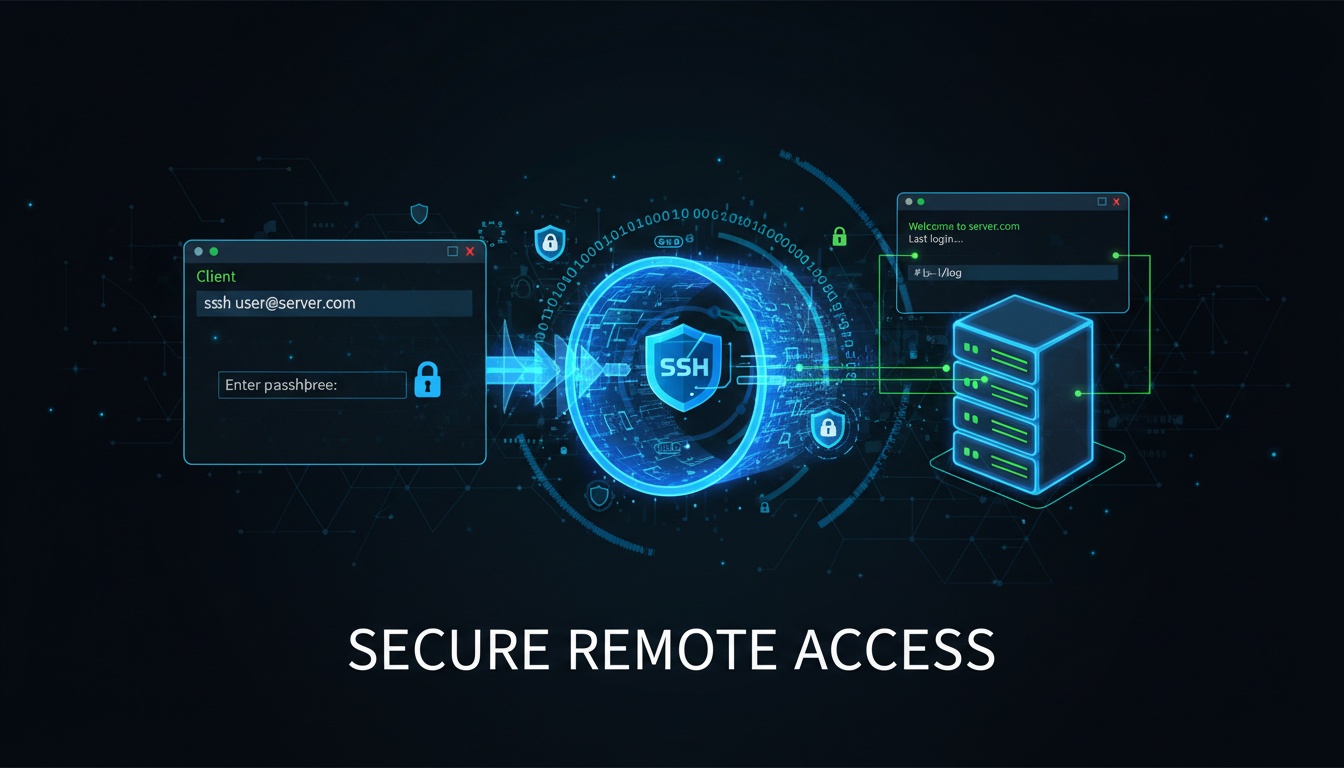
A complete guide to SSH, its meaning, commands, protocol, and how it works
Introduction
SSH (Secure Shell) is one of the most widely used security protocols for remote login, server access, automation, and encrypted communication.
It protects administrators, developers, and automated systems by ensuring that every connection is encrypted, authenticated, and tamper-proof.
In modern cloud and DevOps environments, SSH is fundamental for server access, automation, and secure machine communication.
What This Guide Covers
- SSH definition and meaning
- How SSH works (encryption + handshake)
- SSH flags like -i, -t, -c, -o, -x
- SSH workflow diagrams
- Real commands and examples
- Best practices & common mistakes
- Keyword expansion zone
- Summary & key points
Workflow Diagram — SSH Handshake
1. What Is SSH?
SSH (Secure Shell) is a cryptographic network protocol used to securely connect to remote servers and systems.
SSH Provides:
- Encrypted communication
- Secure authentication (password, key-based, certificates)
- Remote shell access
- Secure file transfer (SCP, SFTP)
- Port forwarding and tunneling
What Problem Does SSH Solve?
- Prevents credential theft
- Stops man‑in‑the‑middle attacks
- Protects against sniffing and replay attacks
- Enables secure remote administration
Who Uses SSH?
- DevOps engineers
- Cloud administrators
- Developers
- Security teams
- Automated systems (CI/CD, bots, pipelines)
2. Why SSH Matters Today
- Ensures encrypted server administration
- Used in cloud services (AWS, Azure, GCP)
- Secure alternative to Telnet & FTP
- Mandatory for Zero Trust systems
- Protects credentials from network attacks
- Works across OS, containers, IoT, and cloud platforms
References:
- NIST SSH Guidelines
- CISA Secure Remote Access
- OWASP Secure Communications
3. How SSH Works (Technical Deep Dive)
SSH operates through these components:
1. Key Exchange (KEX)
- Client and server negotiate encryption parameters
- A secure session key is generated
2. Authentication
Supported methods:
- Password
- Public key (most secure)
- SSH certificates
- Hardware keys (FIDO2, YubiKey)
3. Encrypted Session
All terminal commands, output, and files are encrypted using AES, ChaCha20, or other secure algorithms.
4. SSH Architecture Workflow
- Client starts SSH connection
- Server sends public host key
- Client verifies fingerprint
- Key exchange creates encrypted tunnel
- User authenticates
- Secure shell session begins
- Commands, files, and tunnels operate over encryption
5. Real SSH Commands (Required)
Connect to a Server
ssh user@192.168.1.10SSH with Identity File (-i)
ssh -i ~/.ssh/id_rsa user@server.example.comMeaning:
-i specifies which private key file to use for authentication.
SSH Force Pseudo‑Terminal (-t)
ssh -t user@server "sudo systemctl restart nginx"SSH Disable X11 Forwarding (-x)
ssh -x user@hostSSH With Options (-o)
ssh -o StrictHostKeyChecking=no user@serverSSH Cipher Override (-c)
ssh -c aes256-ctr user@server6. Best Practices
- Use SSH keys instead of passwords
- Enable certificate‑based SSH
- Disable root login
- Rotate keys regularly
- Store private keys in secure vaults
- Use firewall restrictions
- Enable Fail2Ban or rate limiting
- Use SSH over VPN for extra security
- Enforce modern ciphers (AES‑256, ChaCha20‑Poly1305)
- Use SSH agents securely
7. Common Pitfalls
- Leaving password authentication enabled
- Using weak or unencrypted private keys
- Not rotating SSH keys
- Storing private keys in projects or GitHub
- Ignoring host key warnings
- Using outdated ciphers
- Exposing SSH port 22 publicly
8. Advanced Use Cases
- Cloud server access (AWS EC2 SSH)
- CI/CD pipeline automation
- Secure file transfers (SFTP, SCP)
- SSH tunnels for databases
- IoT device management
- Git over SSH
- Kubernetes node access
9. Keyword Expansion Zone
- SSH meaning & definition
- Secure shell definition
- What does SSH mean in networking
- SSH -i meaning
- SSH -t meaning
- SSH protocol explained
- What is SSH access
- What does secure shell do
- SSH client & server explained
- SSH communication protocol
- Is SSH encrypted
- How SSH works internally
- SSH in cloud environments
- What protocol SSH uses (TCP port 22)
Comparison Table
| Feature | Telnet | SSH |
|---|---|---|
| Encryption | None | Strong AES/ChaCha20 |
| Authentication | Plain text | Keys, passwords, certificates |
| Security | Vulnerable | Secure |
| Uses | Legacy systems | Modern servers & cloud |
External Resources
https://www.nist.gov
https://www.cisa.gov
https://www.cloudflare.com/learning
https://learn.microsoft.com/security
https://www.rfc-editor.org/rfc/rfc4251
Looking to implement secure, scalable SSH key lifecycle automation across your enterprise?
Qcecuring helps you modernize SSH, PKI, SSL, and server access with cloud‑native automation.
https://qcecuring.com/request-demo
Final Summary
- SSH provides encrypted remote access
- Protects passwords and commands from attackers
- Works through key exchange + authentication
- Supports keys, certs, and secure shells
- Essential for cloud, DevOps, and secure operations
Ready to Secure Your Enterprise?
Discover how QCecuring can help you automate certificate lifecycle management, secure SSH keys, and protect your cryptographic infrastructure.


